
How Construction Loans Work (and How Progress Payments Actually Get Paid)

Written by Written by Victor Kalinowski, Mortgage Broker and Founder of Blackk
Written by Written by Victor Kalinowski, Mortgage Broker and Founder of Blackk


A construction loan releases money in stages as your build progresses rather than providing the entire amount at settlement. During construction, repayments are usually interest-only and calculated against the amount drawn. What happens after the build depends on the lender and the interest-only period written into the loan agreement. Construction loans are commonly used for new builds, knockdown-rebuilds and major structural renovations in Queensland.
This guide explains the progress payment process, interest charges, valuations, lender requirements and the problems that can arise when a project is delayed or a builder becomes insolvent.
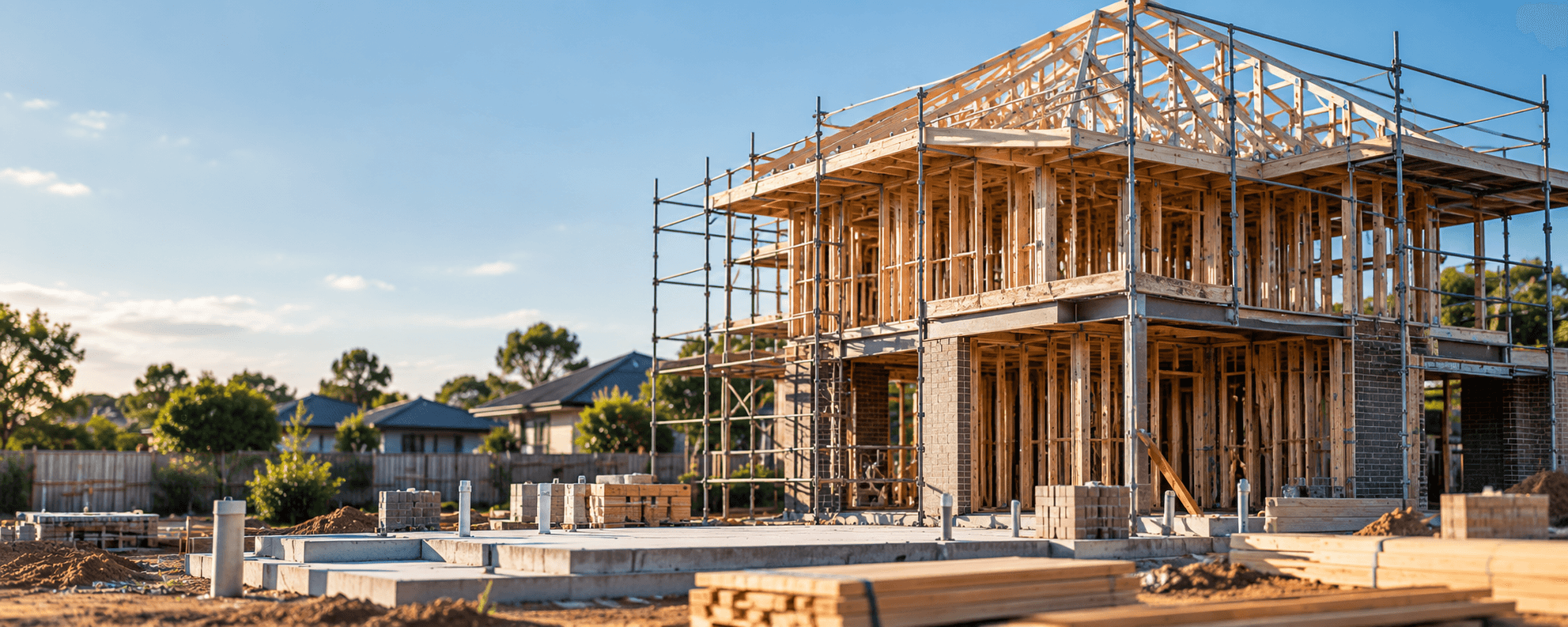
Most people have only ever dealt with a standard home loan. The full amount lands in the vendor's account on settlement day, and you start paying principal and interest immediately. A construction loan works differently on almost every count that affects your wallet.
The valuation is where borrowers can get caught out. The bank estimates what the finished property would sell for in the local market. The land price and construction costs inform that assessment, but they do not determine the final figure on their own.
Most fixed-price residential builds in Queensland follow five stages. Money is released at the end of each stage once the builder can show the work is done. Westpac's residential construction loan guide sets a useful benchmark for what percentage of the loan is typically released at each point.
Westpac's guide notes that in most states no single middle stage should exceed 35% of the contract price, and the final stage should be at least 10%. That's there to protect you. It keeps enough money owed to the builder at the end that they actually finish the job properly.
QBCC also requires progress payments to match actual work completed, and to be clearly written into the contract. If a builder is asking for money ahead of the work, pause. That's a red flag.
A typical progress draw works like this:
1. The builder finishes a stage and issues a progress claim (invoice) to you.
2. You review it, check the work has been done, and authorise the payment.
3. The lender may order a stage inspection or valuation before releasing funds.
4. Once cleared, the lender pays the builder directly. The money doesn't touch your account.
5. Interest starts accruing on the newly drawn amount, on top of anything already drawn.
6. Typical timing from invoice to payment is 3 to 5 business days if the paperwork is clean.
NAB gives a useful example. On a $250,000 approved construction loan, if the first slab invoice is $50,000, you draw only $50,000 at that point. You pay interest on the $50,000, not the full $250,000. Your repayment stays small at the start and grows as more of the loan gets drawn.
Having a construction loan approved does not necessarily mean the lender starts funding the first builder invoice. If the approval requires you to contribute savings or equity, the lender may require that money to be used before it releases loan funds.
Westpac, for example, requires the borrower’s agreed contribution to be paid before the bank begins making progress payments. Ask your broker to confirm how much you must contribute, when it will be needed and whether the builder’s deposit forms part of that amount. This matters for cash flow because your own funds may be required earlier than expected.
During the build, you pay interest only, and only on what's been drawn so far. Each time a stage is paid, your monthly interest bill steps up. By practical completion, you're paying interest on the full loan.
What happens next depends on the loan agreement. Some lenders change the repayment structure after construction, while others keep the loan interest-only until the agreed period expires.
ASIC's MoneySmart illustrates the shift with a $500,000 loan over 25 years at a 4.8% comparison rate. Interest-only repayments start around $2,010 per month. Once the loan converts to principal and interest, repayments jump to around $3,250 per month. That's a $1,240 monthly increase, on the same loan, at the same rate.
The interest-only period is a double-edged sword. It eases cash flow while you're also paying rent or a mortgage on your current place. But it can lull you into thinking you're more comfortable than you actually are. Plan for the P&I repayment now, not on the day the letter arrives. You can check your borrowing power and model what P&I repayments would look like after conversion before you sign anything.
Before the build starts, the lender orders an "as if complete" valuation. A valuer looks at your fixed-price contract, the plans, the block, and comparable finished homes in the area, then puts a number on what the completed property will be worth.
NAB's process is a good template. For builds with a registered builder, inspections and valuations happen at three points: before construction commences, when the first progress claim is made, and when the final progress claim is made. Some lenders inspect at every stage.
Build cost and completed value do not always line up. A second storey in a predominantly single-storey area, premium finishes that local buyers may not pay extra for, or an unusual custom design can produce a valuation below the contract price. The lender calculates the available loan against its valuation, leaving you to cover any shortfall from your own funds.
Most lenders will fund a construction loan up to 80% LVR without lenders mortgage insurance. Some will go to 90 or 95% with LMI, which matters if you're a first home buyer with a smaller deposit.
QBCC sets clear limits on how much deposit a builder can ask for upfront in Queensland:
- Projects up to $3,300: maximum 20%
- Projects $3,301 to $19,999: maximum 10%
- Projects $20,000 and above: maximum 5%
- Up to 20% is allowed where more than half the work by value is custom-built or fabricated off-site
Documents lenders usually want to see:
- Signed fixed-price building contract
- Council-approved plans and specifications
- Builder's licence and certificate of currency (insurance)
- Evidence of QBCC Home Warranty Insurance
- Your usual income, ID and liability documentation
If you're a first home buyer building in Queensland, you may qualify for the $30,000 First Home Owner Grant where the combined value of the home and land is below $750,000. The grant applies to eligible contracts signed on or after 20 November 2023, and the Queensland Government confirmed in its 2026 Budget that the $30,000 amount would continue for contracts signed from 1 July 2026.
Vacant land bought for a first home can also qualify for a full transfer duty concession, reducing the duty to nil. For transactions entered into from 1 August 2026, the buyer must be an Australian citizen, permanent resident or qualifying foreign retiree to receive the concession. The usual eligibility and occupancy requirements still apply.
Cost overruns, delays and builder insolvency are among the main risks borrowers want explained before signing.
Cost overruns. If the build costs more than the contract, someone has to cover the gap. Lenders rarely top up a maxed-out loan mid-build because the "as if complete" valuation hasn't changed. That leaves you funding overruns from savings or a personal loan. It's also why a lump-sum equity draw instead of proper progress payments can be dangerous. It gives you flexibility, but it transfers all the construction risk onto you. If costs blow out or the build stalls, you're paying for a half-finished asset with a loan already at its limit.
Variations. Change something mid-build (bigger kitchen, different tiles) and the builder issues a variation. It gets priced, approved by you in writing, and paid on top of the contract. Small variations are normal. Large ones can trigger a re-valuation.
Builder delays. Most lenders give a build 12 to 18 months. If things stretch beyond that, they'll want a status update and a revised timeline.
Builder liquidation. This is the big fear, and Queensland has real protection. The QBCC Home Warranty Scheme is compulsory for residential construction work valued over $3,300. If a licensed builder can't complete the job because they've gone under, standard cover pays up to $200,000 (with optional cover up to $300,000). Cover lasts for 6 years and 6 months. Non-completion claims require a fixed-price residential contract with a licensed contractor, which is one of the strongest reasons to insist on both.
Once the lender is satisfied with the final inspection and has received the required completion documents, it can release the last progress payment. Check the loan agreement to see when full repayments begin. Practical completion does not always trigger that change automatically, particularly where the agreed interest-only period still has time remaining.
Before that happens, it's worth checking a few things. Is the rate you're on still competitive? Do you want an offset account attached? Would splitting the loan (part fixed, part variable) suit you better now the asset is finished and valued?
This is also the point where refinancing makes sense for some borrowers. The property now has a real, completed valuation instead of a projected one. If the finished home is worth more than expected, that new equity opens up options for the next move or for renovating your home down the track.
Victor Kalinowski has been structuring construction loans for Queensland families since 2007, with more than 19 years in lending. Construction finance isn't a sideline for us. It's a big part of what our small Queensland team does every week.
We compare over 50 lenders, and for construction loans that matters more than it does for standard home loans. Progress payment flexibility, interest-only term length, valuation policy and how each lender handles variations differ far more than their advertised rates. The cheapest rate is rarely the best fit if the drawdown schedule is inflexible.
In 2025, 99.6% of the loans we submitted were approved. We're licensed under an Australian Credit Licence and we'll tell you exactly how we're paid before you commit to anything.
If you're thinking about building, book a free 20-minute call. We'll work out your borrowing power, look at your build costs, and map out how the loan should be structured before you sign a contract. See our construction finance service for more on what we do.
FAQs
Yes, but only on what's been drawn. If you've only drawn the slab payment, you're paying interest on that amount, not the full loan. Repayments grow as more stages are paid.
Approval usually takes 2 to 4 weeks with clean paperwork. The first drawdown (usually the slab claim) comes weeks or months later, once site works are done and the builder invoices.
If you have a fixed-price contract with a QBCC-licensed builder, the Queensland Home Warranty Scheme covers non-completion up to $200,000 (optional $300,000), for 6 years and 6 months. You'd claim through QBCC and engage another builder to finish the job.
Yes, through a variation. The builder prices the change, you approve it in writing, and it's paid on top of the contract. Big variations can trigger a re-valuation.
A construction loan releases funds in stages as the build progresses and charges interest only on the drawn balance. A standard home loan pays out in full at settlement with principal and interest repayments from day one.
Check the interest-only period and conversion terms in your loan agreement. Some lenders change the repayment structure after practical completion, while others do so when the agreed interest-only period expires. If construction finishes early, you may need to ask the lender to switch sooner.
Yes. Knockdown-rebuilds are funded as construction loans, with drawdowns tied to the build stages. Demolition can sometimes be included in the first stage.
For most lenders in Queensland, yes. A fixed-price contract with a licensed builder is what makes the loan work and what activates QBCC Home Warranty cover. Cost-plus arrangements are much harder to fund. If you want to talk through your options, a quick chat with a Brisbane mortgage broker who handles construction regularly is the fastest way to get clear.
References

Victor Kalinowski
Mortgage Broker and Founder of Blackk
I’m Victor Kalinowski and a Brisbane Mortgage Broker at Blackk Mortgage Brokers. I’ve helped thousands of people get loans for their homes and investment properties.


99.9% Approval Rate
Insider advice to negotiate making a successful offer on a home

Award Winning Mortgage Broker
If you are happy with the service from your current lender, but would like a better deal.

Work with Victor, not with random brokers
If you are happy with the service from your current lender, but would like a better deal.
with 99.6% first time success rate
No Obligations
with 99.6% first time success rate
No Obligations


Subscribe to get tips on home loans and property straight to your inbox
By downloading you agree to receiving occasional and only useful emails from us.

