
Loan-to-Value Ratio (LVR) Explained for Home Buyers

Written by Written by Victor Kalinowski, Mortgage Broker and Founder of Blackk
Written by Written by Victor Kalinowski, Mortgage Broker and Founder of Blackk


What LVR is, how to calculate it, and how it shapes your rate, deposit and lender options in Australia.
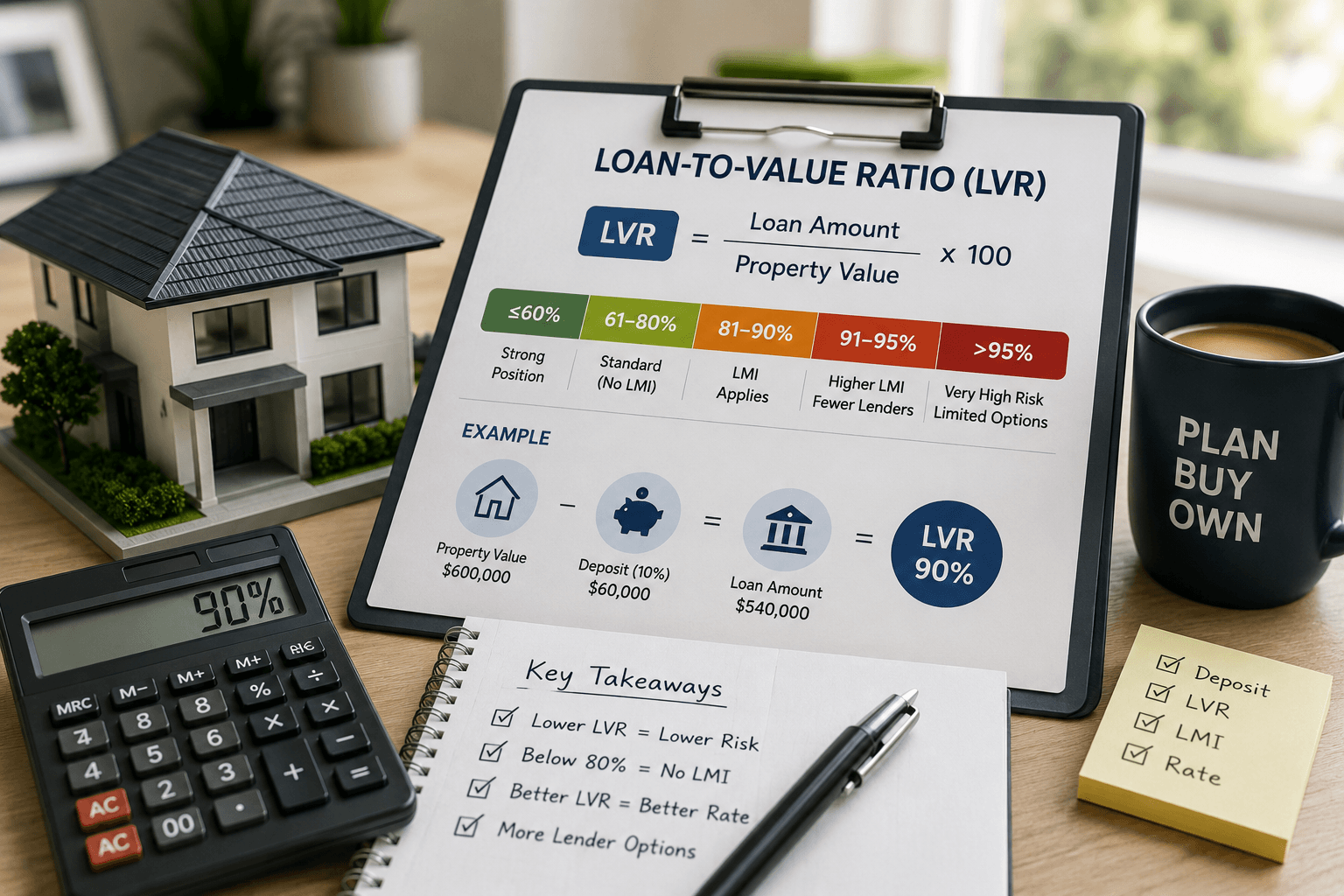
LVR stands for loan-to-value ratio. It's your loan amount divided by the value of the property, shown as a percentage. Lenders read it as a quick risk signal. The higher your LVR, the more they've lent against the property, and the less buffer they have if things go sideways.
Here's the formula:
LVR = (Loan Amount ÷ Property Value) × 100
Say you're buying a $500,000 home with a $50,000 deposit. You borrow $450,000. That's a 90% LVR.
The 80% line is the one to watch. Above it, most lenders will ask you to pay lenders mortgage insurance. Below it, you sit in cheaper, easier territory. Every rate quote, LMI premium and lender policy flows from where your LVR lands.
The maths is straightforward. Divide your loan by the property value, then multiply by 100. MoneySmart gives a clean example: borrow $450,000 to buy a $600,000 home and your LVR is 75%.
Two things to watch. First, the lender uses their own valuation, not always the purchase price. If the bank values the place lower than what you paid, your LVR goes up. Second, stamp duty and other buying costs aren't part of the calculation. LMI only counts if it's capitalised into the loan.
Lenders group borrowers into LVR bands. Each band changes what you'll pay and which lenders will look at your file. And if you're worried about ending up in the higher bands, you've got plenty of company. APRA's March 2026 quarterly figures show 16.7% of residential exposures across Australian banks sit at 80% LVR or above, and 30.7% of new loans funded that quarter were at 80% LVR or higher.
Not sure where you'll land? Check your borrowing power before you start looking at houses. It's the fastest way to work out which band you're in.
What happens when LVR goes above 80%?
Cross 80% and you're usually paying LMI. Lenders mortgage insurance protects the lender if you default, not you. It's a one-off premium, and most lenders let you capitalise it into the loan so you don't pay it upfront. The trade-off is you're paying interest on it over the life of the loan.
The premium scales with LVR. A 90% loan costs more in LMI than an 85% loan. A 95% loan costs more again. Before you settle on a deposit size, it's worth understanding how LMI works and what it'll actually cost you.
APRA's residential mortgage practice guide (APG 223) flags LVRs above 90%, including capitalised LMI, as clearly higher-risk lending. That's why lender policies tighten sharply above 90%. Fewer lenders. Tighter servicing. More scrutiny on the property itself.
There's a way around LMI if you qualify. MoneySmart notes the Australian Government's 5% Deposit Scheme lets eligible first-home buyers purchase with as little as a 5% deposit (2% for single parents or legal guardians) without paying LMI. The government guarantees the difference. It's not automatic. Place limits and property price caps apply. But it's the cleanest path to a 95% LVR loan without the LMI cost.
Does LVR affect your interest rate?
Yes, and more than most people realise. Lenders price risk in tiers. Lower LVR, lower rate. It's not always a smooth curve either. Some lenders have sharp breakpoints at 70% and 80% LVR where the rate steps down noticeably. Others hold rates flat up to 80% then price up. Rate-comparison sites rarely show this.
After 19+ years in lending, this is one of the details we watch closely. Two borrowers with identical incomes can end up on quite different rates purely because one sits at 79% LVR and the other at 81%.
It's also why refinancing into a lower LVR band once your property value grows can be worth a look. If you bought at 90% LVR and the property has since risen in value, a fresh valuation might drop you into the 80% or 70% band and a cheaper rate.
Saving harder is the obvious answer. It's not the only one.
- Bigger deposit. Every extra dollar down drops your LVR, and past 80%, your LMI bill.
- First Home Guarantee. Eligible first-home buyers can borrow at 95% LVR without paying LMI under the scheme.
- Family guarantee. A parent uses equity in their property as additional security. Your effective LVR drops without you needing more cash. Structured well, it's one of the ways to reduce your LMI premium if you're borrowing above 80%.
- Wait for growth, then refinance. If your property value climbs, a new valuation can move you into a lower band.
- Extra repayments. Chipping down the principal faster builds equity and lowers LVR over time.
- Buy a bit cheaper. Sounds obvious. A $50,000 lower purchase price on the same deposit changes your LVR meaningfully.
Which strategy fits depends on your timeline, your income and the state of your deposit right now.
LVR rules aren't identical across every loan. Here's the shape of it.
Owner-occupier. Most lenders will go to 95% LVR with LMI, or 80% without. A handful go to 98% with capitalised LMI, but the pool shrinks fast.
Investment property. Caps are usually tighter. Many lenders stop at 80% LVR for investment loans, some go to 90%, and 95% is rare. LMI still applies above 80%. Servicing tests are stricter too. Investment property lending has its own set of LVR caps and lender preferences that don't line up with owner-occupier rules.
Refinance. Your current property valuation drives the new LVR, not the price you originally paid. If prices have moved, so has your LVR, up or down.
Construction. LVR is calculated on the total end value, which is land value plus fixed-price build contract. Progress payments are drawn as the build hits stages. Some lenders cap construction LVR lower than standard purchases.
FAQs
Under 80% is the standard benchmark. No LMI, widest pool of lenders, sharpest rates. Under 60% is even better, and some lenders offer a further rate discount at that level. That said, "good" depends on your situation. A 90% LVR loan with the First Home Guarantee behind it can be a smart move for a first-home buyer who'd otherwise wait years to save 20%. The right LVR is the one that gets you into a suitable property without overstretching your repayments.
No. Stamp duty, legal fees and moving costs sit outside the LVR calculation. LVR is purely loan divided by property value. But stamp duty still matters, because if you use your savings to cover it, you have less left for the deposit. That pushes your LVR up. Some lenders in some states allow stamp duty to be capitalised into the loan, which changes the numbers again.
Yes, though the lender pool narrows and LMI costs climb. A 95% LVR home loan is standard territory for first-home buyers with a 5% deposit. If you qualify for the First Home Guarantee, you can borrow at 95% LVR without paying LMI. Outside the scheme, expect LMI premiums running into the tens of thousands, usually capitalised into the loan.
The lender orders a valuation. For straightforward purchases, that's often a desktop or kerbside valuation using recent comparable sales. For higher-value, unusual or high-LVR loans, a full inspection valuation is common. The lender uses the lower of the contract price or the valuation. If the valuation comes in short, your LVR goes up and you may need more deposit.
They can. Lenders keep internal lists of postcodes flagged as higher risk, usually mining towns, some regional areas, or postcodes with high investor concentration. In those areas, maximum LVR caps drop, sometimes to 70% or 80%, even for owner-occupiers. The property still gets valued the same way, but the ceiling is lower. A broker who knows lender policies can save you from applying to the wrong bank.
Most lenders will refinance up to 80% LVR without LMI. Above 80%, LMI applies again, and you may not recoup it if you're only chasing a small rate saving. If you're refinancing to release equity, cash-out policies tighten above 80% too. A fresh valuation can help or hurt here. Worth checking before you switch.
Usually yes. Most lenders let you capitalise LMI, meaning it's added to your loan balance rather than paid upfront. You'll pay interest on it over the loan term, but it keeps your cash free at settlement. APRA's guidance treats capitalised LMI as part of the LVR calculation, so a 90% LVR loan with LMI capitalised on top can push the effective LVR above 90%.
It does. LVR feeds into pre-approval decisions because it shapes which lenders will look at your file, what rate you'll be offered, and whether LMI applies. A pre-approval at 80% LVR is a different conversation to one at 95%. Knowing your target LVR before you start looking helps set a realistic property price range.
References

Victor Kalinowski
Mortgage Broker and Founder of Blackk
I’m Victor Kalinowski and a Brisbane Mortgage Broker at Blackk Mortgage Brokers. I’ve helped thousands of people get loans for their homes and investment properties.


99.9% Approval Rate
Insider advice to negotiate making a successful offer on a home

Award Winning Mortgage Broker
If you are happy with the service from your current lender, but would like a better deal.

Work with Victor, not with random brokers
If you are happy with the service from your current lender, but would like a better deal.

with 99.6% first time success rate
No Obligations


Subscribe to get tips on home loans and property straight to your inbox
By downloading you agree to receiving occasional and only useful emails from us.

